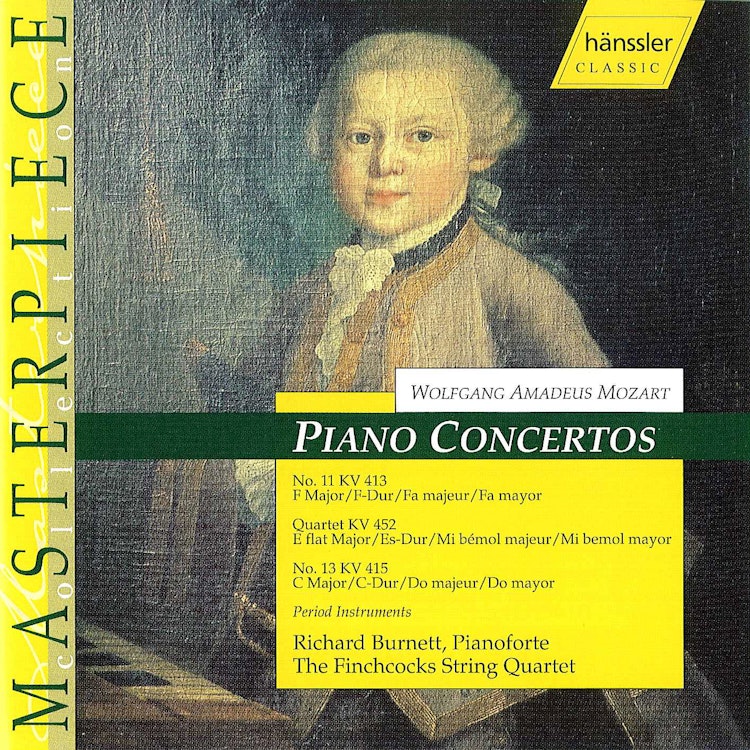
Mozart: Piano Concertos Nos. 11 and 13 (arr. for piano quintet)
1/1/2000, 9 Tracks, 1:12:27
Featuring
Richard Burnett
Finchcocks String Quartet
Wolfgang Amadeus Mozart
Did you know?
1/7
Compositional Technique
In these concertos, Mozart ensured that only the piano and strings are essential, with other instruments merely doubling string parts, allowing for chamber music interpretations.
Instruments
The fortepiano used in this recording, built by Michael Rosenberger in Vienna, is an example of the instrument type Mozart played, featuring knee levers for sustaining and tone alteration.
Composer's Artistic Vision
Mozart deliberately scored these concertos so they could be performed as piano quintets or with a full orchestra, aiming to make them accessible to a wider audience.
Composition History
Mozart wrote Piano Concertos Nos. 11 and 13 in F major and C major, respectively, along with No. 12, in the autumn of 1782 for his subscription concerts in Vienna.
Performer Biography
Richard Burnett, the fortepiano player on this album, began his interest in early pianos in the 1960s and founded Finchcocks, a museum housing his collection of historical pianos.
Recording & Production
The fortepiano for this recording was prepared and tuned by William Dow, the curator of the Finchcocks Museum.
Interpretation
Performing these concertos as piano quintets with period instruments offers a stylistic advantage, as the 'Mozart' piano blends naturally with strings while providing a piquant contrast.
You might also enjoy...
Mozart: Piano Concerto Nos. 12 & 20 (chamber versions)
Mozart Piano Concertos 11, 12, & 13
Haydn: Piano Concerto in F Major, Hob.Xviii:3 / Piano Concerto in G Major, Hob.Xviii:4
Mozart: Romantic Mozart (The)
Moscheles: Piano Concertos Nos. 2 & 3 (Hyperion Romantic Piano Concerto 29)
Mozart & Shostakovich: Concertos for Piano and Strings & Piano Sonata
Adagio - The Ultimate Collection
Francis Poulenc: Piano Concerto & Concert Champêtre