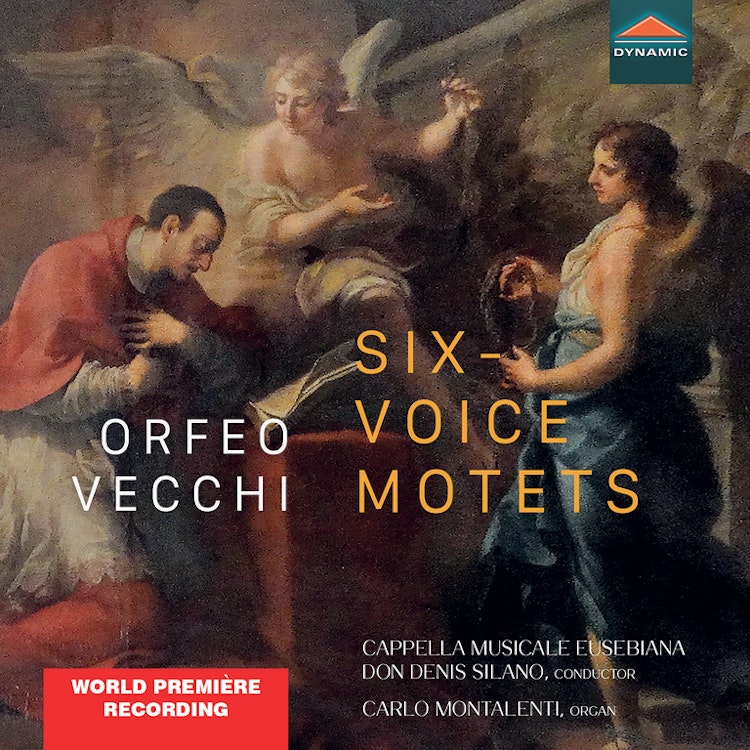
Orfeo Vecchi, Six-voice Motets, Motectorum sex vocibus liber tertius (Milan 1598)
2/16/2024, 20 Tracks, 1:06:36
Featuring
Denis Silano
Carlo Montalenti
Cappella Musicale Eusebiana
Orfeo Vecchi
Did you know?
1/7
Historical Context
Orfeo Vecchi's music was considered a 'faithful interpreter of the Tridentine ideals' as promoted by Carlo and Federico Borromeo, important figures in the Counter-Reformation.
Interpretation
The performance alternates pieces with and without organ accompaniment, consistently using meantone temperament, which Orfeo Vecchi would have encountered.
Composer Biography
Orfeo Vecchi, born around 1551 in Milan, received his cultural and musical training at the Collegio degli Innocenti in Vercelli.
Recording & Production
This album is a world première recording of Orfeo Vecchi's Six-voice Motets.
Compositional Technique
Vecchi's motets feature a marked antiphony, using six voices to create dialogue between choral groups, often contrasting the three upper voices with the rest.
Critical Reception
Seventeenth-century theologian Filippo Picinelli praised Orfeo Vecchi, stating he 'outdid them all with both the quantity and refinement of his works' and could compose a motet in the time it took others to write a letter.
Composition History
Orfeo Vecchi's collection, Motectorum sex vocibus liber tertius, was published in Milan in 1598 and reprinted in its entirety in 1603, the year of his death.