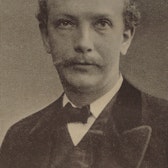
Richard Strauss considered Ein Heldenleben (A Hero's Life) and Don Quixote to be direct companions, believing Don Quixote could only be fully understood alongside Ein Heldenleben.
Composer's Artistic Vision
For Tod und Verklärung, Richard Strauss wrote his own program, intending to depict the final hour of an artist striving for the highest goals, with the soul finding consummation in the cosmos.
Composition History
Richard Strauss's symphonic poem Tod und Verklärung (Death and Transfiguration) was premiered in Eisenach on June 21, 1890, conducted by the composer.
Historical Context
In the 19th century, composers like Richard Strauss debated whether the symphony, as perfected by Beethoven, still offered creative possibilities or if new forms like the symphonic poem were needed.
Composer Biography
In Ein Heldenleben, Richard Strauss depicted his critics as 'The Hero's Adversaries' and his wife, Pauline, as 'The Hero's Companion,' describing her as complex and multifaceted.
Composer's Artistic Vision
Richard Strauss initially rejected Richard Wagner and was influenced by Brahms, but later embraced the symphonic poem form after meeting violinist Alexander Ritter.
Composer Biography
Alexander Ritter, a violinist, encouraged Richard Strauss to read Arthur Schopenhauer, whose philosophy influenced Wagner's ideas.
You might also enjoy...
R. Strauss: An Alpine Symphony, Op. 64, TrV 233
R. Strauss: Don Quixote & Till Eulenspiegel
R. Strauss: Tone Poems, Vol. 4
Richard Strauss: Ein Heldenleben; Till Eulenspiegels lustige Streiche
Strauss: Don Quixote, Op. 35 & Tod und Verklärung, Op. 24
Richard Strauss: Also sprach Zarathustra; Don Juan
Joseph Keilberth conducts Richard Strauss Orchestral Works
Strauss: Ein Heldenleben & Don Juan
Strauss: Don Quixote - Tod und Verklärung
Strauss: Also sprach Zarathustra; Ein Heldenleben
R. Strauss: Don Juan, Op. 20 & Tod und Verklärung, Op. 24