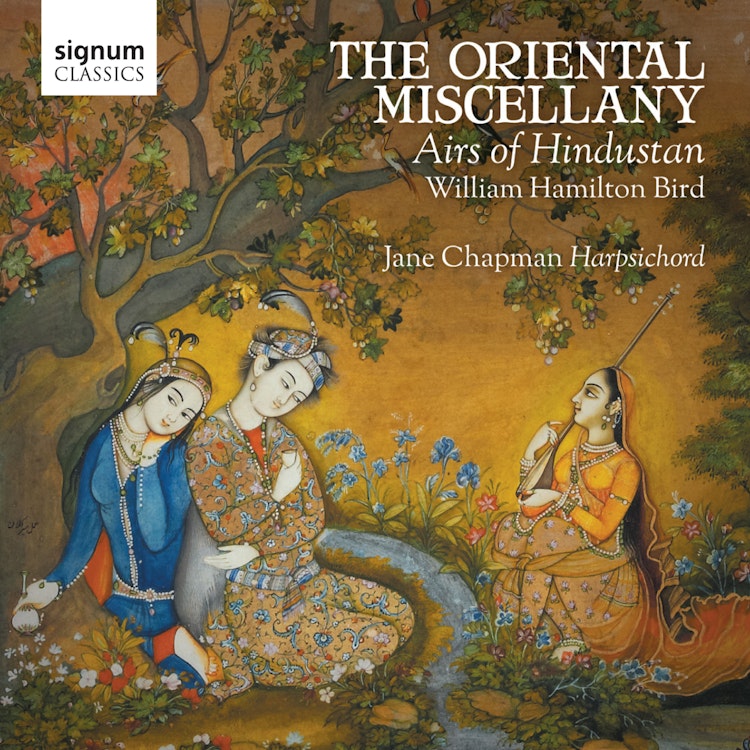
This recording was inspired by Gerry Farrell's book 'Indian Music and the West' and was undertaken as a research project at King's College London, funded by the Leverhulme Trust.
Interpretation
The performer, Jane Chapman, incorporates improvisations in the style of an Indian ālāp before several pieces, exploring the rāg on which the song may have been based, similar to 17th-century préludes non mesurés.
Composition History
William Hamilton Bird's "The Oriental Miscellany" was first published in Calcutta in 1789 and later in Edinburgh, dedicated to the first Governor-General of India, Warren Hastings.
Compositional Technique
William Hamilton Bird's "Oriental Miscellany" includes a Sonata for harpsichord with violin or flute accompaniment, which weaves 'select passages' from at least 8 of the airs into its movements, possibly making it the first work of East-West fusion.
Performer Biography
Jane Chapman, described as 'Britain's most progressive harpsichordist', has premiered over 200 solo, chamber, and electroacoustic works worldwide and is a professor of harpsichord at the Royal College of Music, London.
Instruments
The harpsichord used for this recording is a double manual Jacob Kirckman harpsichord from London, 1772, known for its five-octave compass, three sets of strings, and lute and machine stops.
Historical Context
The publication of "The Oriental Miscellany" came at a crucial time for William Hamilton Bird, a 'Conductor of public amusements' in Bengal, as he was facing mounting debts.
You might also enjoy...
Lemniscate - Bach: The Art of Fugue
J. S. Bach: Sonatas for Viola da Gamba and Harpsichord
Bach: Sonate à Cembalo è Viola da Gamba
Bach: Sonatas for Viola da gamba and Harpsichord, BWV 1027-1029, 1019
Spiegelungen: Bach's Musical Offering in dialogue with Viktor Kalabis and Isang Yun
Bach: Musiche per Clavicembalo e Viola da Gamba
Bach: Music for Harpsichord & Viola da gamba
Benda: Keyboard Sonatas
Pièces de Clavecin, Premier Livre, Quatriême Ordre
J.S. Bach: Sonata for Viola da Gamba and Harpsichord in G Minor, BWV 1029: III. Allegro
Frescobaldi: Toccate & Partite d'Intavolatura di Cimbalo & Organo, Libro 2