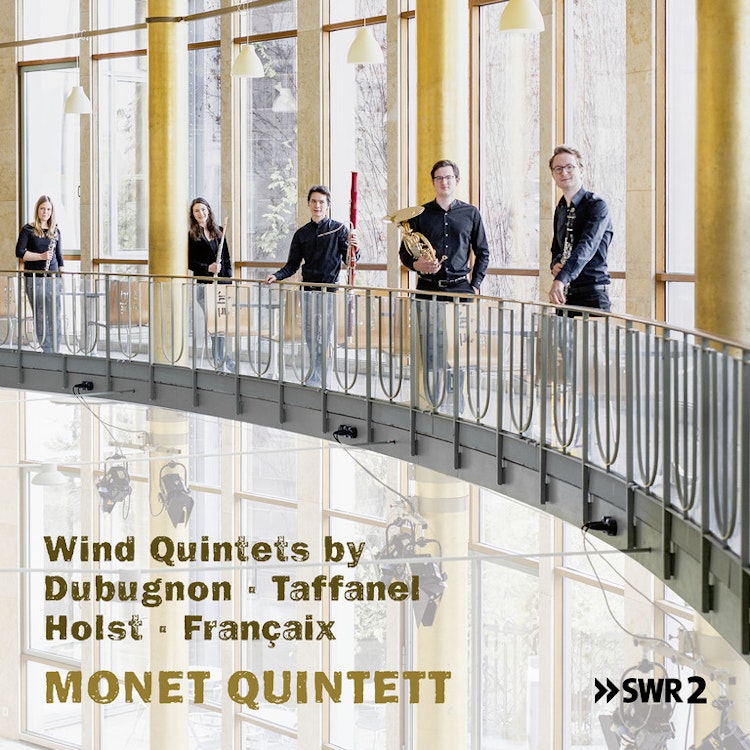
Dubugnon, Taffanel, Holst and Françaix: Wind Quintets
9/11/2020, 12 Tracks, 1:09:13
Featuring
Anissa Baniahmad
Johanna Stier
Nemorino Scheliga
Marc Gruber
Theo Plath
Monet Quintett
Richard Dubugnon
Paul Taffanel
Gustav Holst
Jean Françaix
Did you know?
1/7
Compositional Technique
Paul Taffanel's Quintet was innovative for its time by liberating the horn and bassoon from their typical accompaniment roles, allowing them to participate in melodic events.
Composition History
Gustav Holst's Wind Quintet in A Flat Major, Op. 114, composed in 1903, was never performed during his lifetime and was only rediscovered in 1978 and published by his daughter Imogen.
Composition History
Paul Taffanel, a French flutist and composer, composed his Quintette pour instruments à vent in 1876 to revive the wind quintet genre's popularity.
Composer's Artistic Vision
Richard Dubugnon's Frenglish Suite incorporates influences from both English and French composers, and draws melodic material from the folk songs 'Geordie' and 'À la claire fontaine'.
Composition History
Jean Françaix's Wind Quintet No. 1, written in 1948, was considered technically unplayable for six years until five players from the Orchestre National in Paris premiered it in 1954.
Compositional Technique
Jean Françaix's Wind Quintet No. 1 is known for its extreme demands on virtuosity, with challenging tempi, dynamics, and instrument ranges, yet maintains a light and charming character.
Historical Context
The wind quintet, a combination of flute, oboe, clarinet, horn, and bassoon, was popular in 18th-century noble courts but declined after the French Revolution.
You might also enjoy...
Dubugnon, Taffanel, Holst and Françaix: Wind Quintets
Onslow: Sextet No. 1 - Septet in B-Flat Major - Nonet in A major, Op. 77 - Wind Quintet in F major, Op. 81
Boccherini: Cello Sonatas (Live)
Ravel, Françaix, Taffanel & Ibert: Chamber Works
Romantique
Schuller, G.: Suite for Wind Quintet / Piston, W.: Wind Quintet / Carter, E.: 8 Etudes and A Fantasy / Diamond, D.: Partita