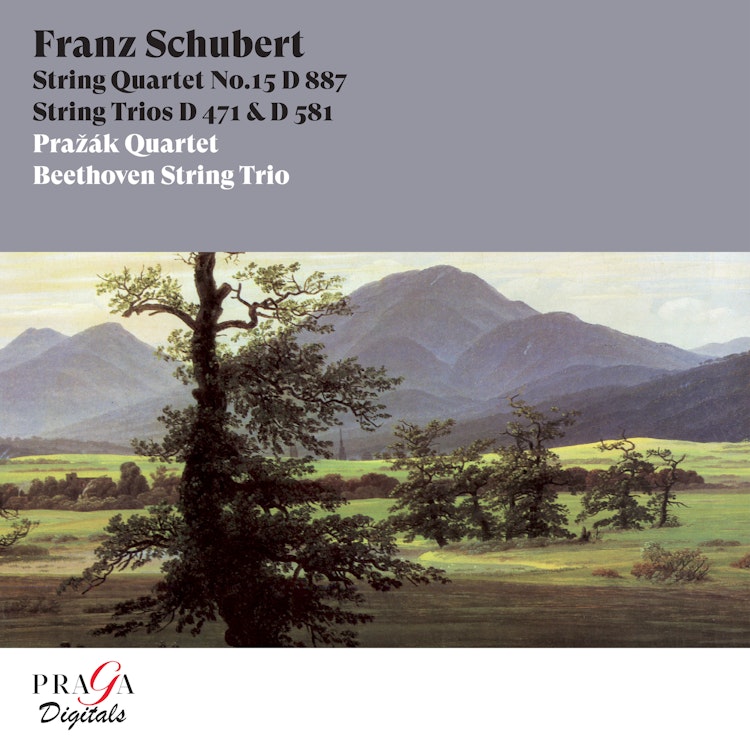
Franz Schubert: String Quartet No. 15, String Trios D. 471 & D. 581
1/1/2008, 9 Tracks, 1:15:59
Featuring
Václav Remeš
Vlastimil Holek
Josef Klusoň
Michal Kaňka
Pavel Hůla
Pražák Quartet
Beethoven String Trio
Franz Schubert
Did you know?
1/7
Critical Reception
Schubert's String Quartet in G major D. 887 was considered too 'orchestral' by contemporary critics and was rarely programmed for over a hundred years due to its instrumental and intellectual demands.
Composition History
Schubert's last and most original quartet, the String Quartet in G major D. 887, was composed in just ten days in June 1826.
Composer's Artistic Vision
In the String Quartet in G major D. 887, Schubert aimed to replace the traditional tonic-dominant contrasts with contradictory harmonic elements, opening the way for the modern 20th-century quartet.
Notable Performances
The first movement of Schubert's String Quartet in G major D. 887 was performed publicly in 1828, marking the only success Schubert witnessed for this work during his lifetime.
Performer Biography
The Beethoven String Trio is comprised of Czech musicians Pavel Hůla (primarius of the Kocian Quartet), Josef Klusoň, and Michal Kaňka (violist and cellist of the Pražák Quartet).
Compositional Technique
The String Quartet in G major D. 887 prefigures the Second Vienna School with its major/minor ambivalence, perpetual permutations of basic keys, and chromaticism in the inner voices.
Performer Biography
The Pražák Quartet, founded by students at the Prague Conservatory, won the First Prize at the Evian International Competition in 1978 and the Prague Spring Festival Prize in 1979.
You might also enjoy...
Joseph Haydn: Four Baryton Trios (Remastered 2022)
Wolf-Ferrari: String Trios, Quartets & Quintet
Egon Wellesz: Chamber Music
Haydn: Baryton Trios, Vol. 2
Haydn: Baryton Trios
Hungarian Serenade
Silenced Voices
Klein, Krása, & Schulhoff: Forbidden Music
Klein, G.: String Trio / Schulhoff, E.: Duo for Violin and Cello / Violin Sonata / Krasa, H.: Passacaglia and Fugue / Tanz