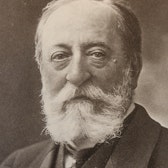
Camille Saint-Saëns, born in Paris in 1835, was a child prodigy who had memorized all Beethoven piano sonatas by age ten.
Composer Biography
Saint-Saëns taught briefly at the newly established Ecole Niedermeyer, where his pupils included Gabriel Fauré, a musician with whom he established a close relationship.
Performer Biography
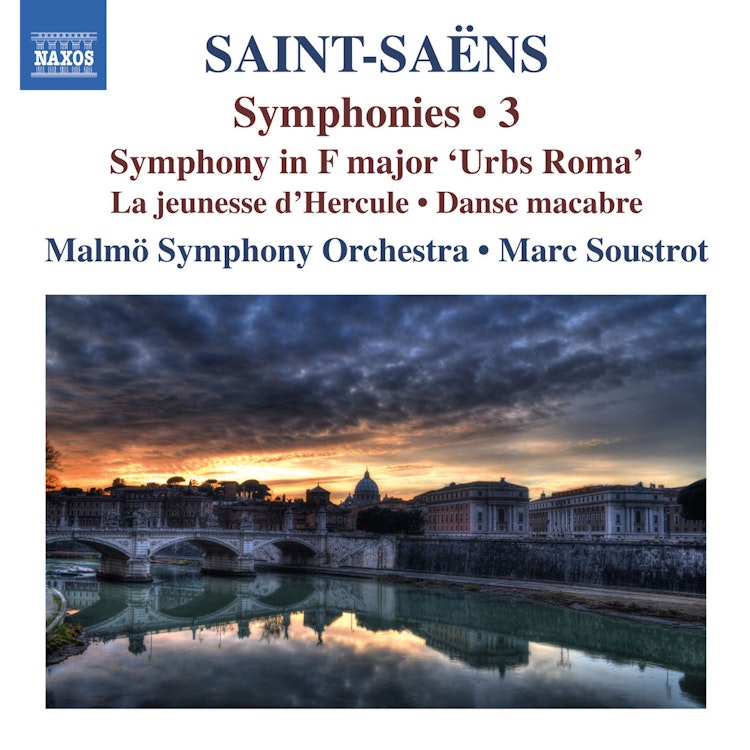
Marc Soustrot, the principal conductor of the Malmö Symphony Orchestra, was honored with the title Chevalier de la Légion d'Honneur in 2008.
Compositional Technique
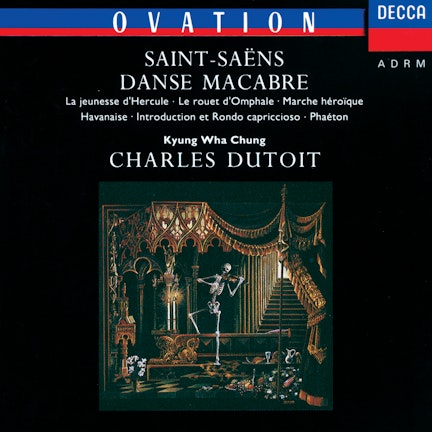
The 'Danse macabre' by Saint-Saëns uniquely includes a xylophone in its orchestration to suggest the rattling of dry bones.
Composition History
Saint-Saëns' Symphony in F major 'Urbs Roma' was written in 1856 for a competition organized by the Bordeaux Société Ste Cécile, requiring anonymous submission.
Historical Context
After the Franco-Prussian War in 1871, Saint-Saëns was instrumental in founding the Société Nationale de Musique, which aimed to promote French music.
Compositional Technique
In 'Danse macabre', the solo violin, representing Death, has its top string tuned down to E flat, creating a tritone with the A string, traditionally known as 'the devil in music'.
You might also enjoy...
Franck: Orchestal Music, Vol. 1 - Symphony in D Minor / Le Chasseur Maudit / Les Eolides
Franck: Symphony in D Minor - Rédemption - Le chasseur maudit