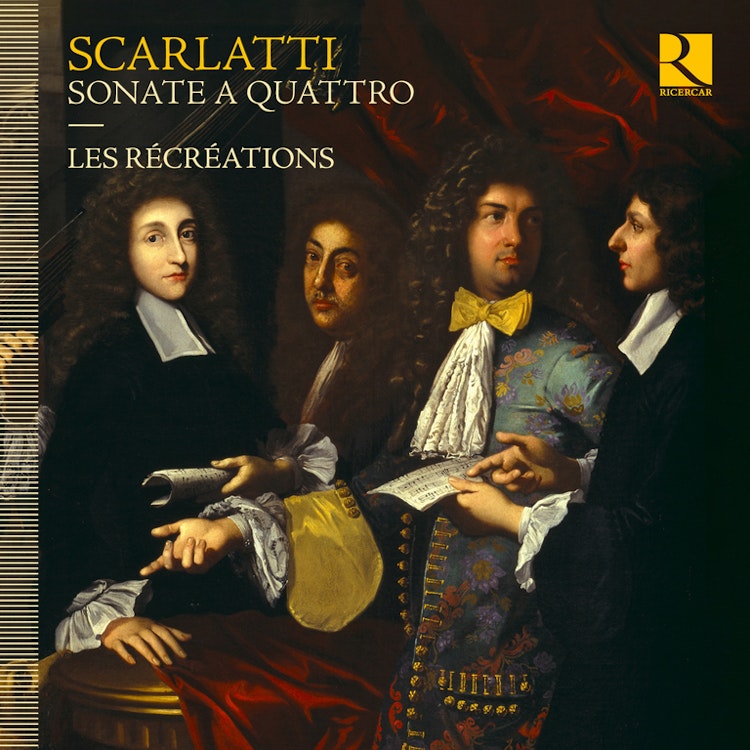
Alessandro, Francesco & Domenico Scarlatti: Sonate a quattro
4/9/2021, 32 Tracks, 59:21
Featuring
Matthieu Camilleri
Sandrine Dupé
Clara Mühlethaler
Keiko Gomi
Étienne Galletier
Les Récréations
Alessandro Scarlatti
Giovanni Maria Trabaci
Carlo Gesualdo
Francesco Scarlatti
Domenico Scarlatti
Did you know?
1/7
Historical Context
Ferdinando de' Medici, a patron and artist himself, collected Stradivarius instruments and his court was at the forefront of musical discoveries, including the first pianofortes by Cristofori.
Composer Biography
Francesco Scarlatti, Alessandro's brother, lived in Alessandro's shadow and had a career marked by failures, though he collaborated closely with his brother as an emissary in Sicily.
Critical Reception
Alessandro Scarlatti's four sonatas achieved posthumous popularity and immortality through a post-Corellian arrangement by Charles Avison, who misleadingly attributed them to a non-existent "Stefano Scarlatti."
Composition History
Alessandro Scarlatti's Sonate a quattro senza cembalo are unique for their explicit exclusion of the harpsichord, which was typically the foundation of the continuo in instrumental ensembles of the 1700s.
Composer's Artistic Vision
Alessandro Scarlatti, described by a contemporary as "the man most learned in counterpoint," was a musical colorist inclined towards harmonic experimentation, developing a daring and unusual musical language.
Compositional Technique
The Sonate a quattro are characterized by a predominance of counterpoint, a solemnity reinforced by the choice of minor keys, and an innovative movement order, with three sonatas beginning directly with a masterful fugue.
Composer's Artistic Vision
The term "a tavolino" in the title of Alessandro Scarlatti's sonatas suggests they might have been conceived as instrumental madrigals, referencing the Renaissance practice of singers performing madrigals around a table without keyboard accompaniment.
You might also enjoy...
La rosa e la dea
1723: Bach, Bertali, Biber, Corelli & Pisendel
Telemann: Chamber Works
Fondo Barocco: Baroque Cello Sonatas
Wien Am Hofe Leopolds I
The Italian Album
Fontana: Complete Sonatas for Violin and B.C.
Couperin: Pièces de viole
Bach, J.S.: Sonatas for Viola Da Gamba and Harpsichord
Biber, Schmelzer, Mealli, Böddecker
Ostinato
Chameleon
Transition baroque : Joseph Bodin de Boismortier (Trente et Unième œuvre & Œuvre Cinquantième)