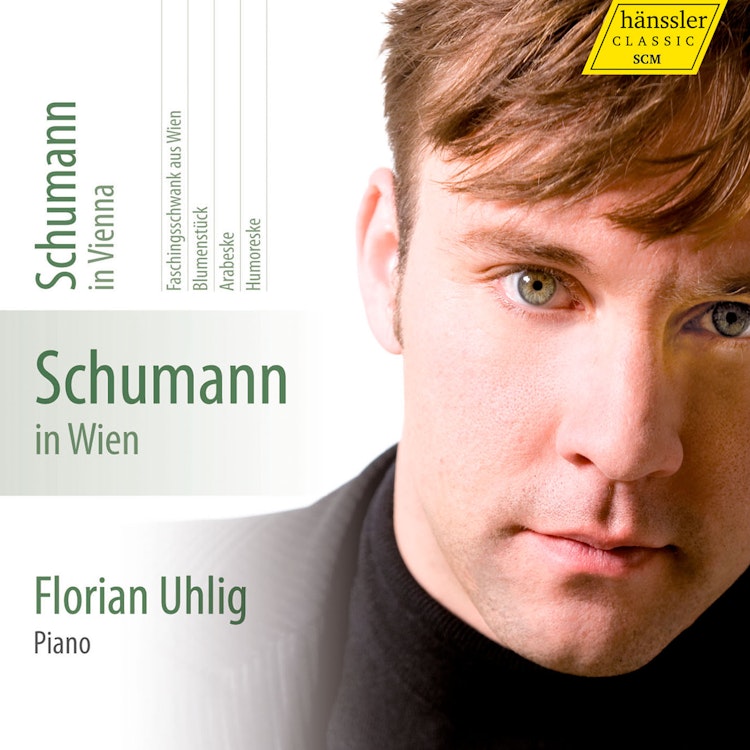
Schumann: Complete Piano Works, Vol. 4 - Schumann in Wien
10/2/2012, 18 Tracks, 1:11:51
Featuring
Florian Uhlig
Robert Schumann
Did you know?
1/7
Historical Context
Schumann found Vienna's musical taste to be superficial and conservative, writing to Clara Wieck that 'stupidity and brutality' dominated music there.
Compositional Technique
The Humoreske op. 20 features a puzzling 'inner voice' on a separate staff, which Clara Schumann explained was meant to be sensed by the listener rather than explicitly played.
Composer Biography
Robert Schumann's six-month stay in Vienna from late 1838 to early 1839 was intended to move his music journal, Neue Zeitschrift für Musik, there and secure his livelihood with his fiancée Clara Wieck.
Composer's Artistic Vision
Schumann believed that the aesthetics of different arts were the same, only the material differed, stating 'the picture becomes the painter's music, the musician puts the paintings to music'.
Recording & Production
The booklets for this complete Schumann piano works series are written by Joachim Draheim, who has also discovered and edited some of the works.
Album & Artwork
This album is part of a 15-CD project by Florian Uhlig, aiming to be the first truly complete recording of Robert Schumann's solo piano works.
Composition History
Schumann's Humoreske op. 20 was completed in Vienna in March 1839, after being started in Leipzig in April 1838.
You might also enjoy...
Zwielicht (Schumann: Piano Works)
Schumann: Arabeske
Schumann, R.: Fantasiestücke, Op. 12 / Brahms: Klavierstucke, Op. 118