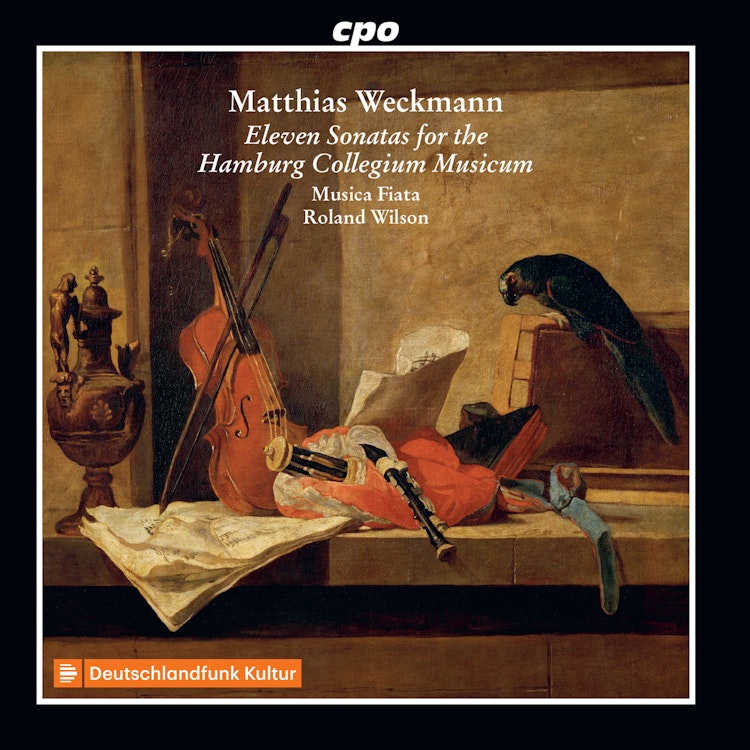
Matthias Weckmann, born around 1616, was a boy soprano in the Dresden Hofkapelle, where Hofkapellmeister Heinrich Schütz oversaw his musical education.
Compositional Technique
Weckmann's sonatas feature strong contrasts, including sudden changes in tempo, meter, and tessitura, as well as alternating polyphonic and homophonic passages.
Composer Biography
Matthias Weckmann competed against Johann Jakob Froberger, a visiting composer from Vienna, in Dresden and won, leading to a lifelong friendship.
Composition History
In 1660, Weckmann co-founded the 'Collegium musicum' in Hamburg, an ensemble dedicated to rehearsing and performing the best music from major European cities.
Composition History
Weckmann's career was affected by the Thirty Years' War, which caused difficulties like irregular payment, leading him to leave the Dresden court for a time.
Composer's Artistic Vision
Weckmann wrote his sonatas for an audience of 'connoisseurs'—a collective of composers and musicians—meaning he did not have to make concessions for a general public.
Instruments
The sonatas on this album are heard in their correct historical pitch, the high Chorton, which was at least a semitone higher than today's standard pitch.
You might also enjoy...
Couperin: Pièces de viole
The Virtuoso Oboist (Thomas Vincent, Sonatas, Op. 1 for Oboe and Continuo)
Fondo Barocco: Baroque Cello Sonatas
Transition baroque : Joseph Bodin de Boismortier (Trente et Unième œuvre & Œuvre Cinquantième)
1723: Bach, Bertali, Biber, Corelli & Pisendel
L'Univers de Marin Marais
Defense de la basse de viole contre les entreprises du violon et les pretentions du violoncelle
Spicy - Exotic Music for Violin by Biber, Schmelzer & Fux
Venetian Cello Sonatas. Under the Shade of Vivaldi
Pisendel. Neue Sonaten
C.P.E. Bach: Concerti for Cello, Strings & Basso continuo
Dornel: Chamber Music for Recorders, Flute and Continuo